
Letter N
Letter n is pronounced with the tongue closing the roof of the mouth behind the teeth and air flowing through the nose, much as in English.Click on a video below to see and hear Mrs. Irene Arnold pronouncing words with N.
ná' take it
xen quickly
nen you
sheen summer
nûun animal
jâan this one
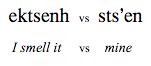
n vs. nh
Tanacross also has a distinct sound similar to n but made without the vocal cords vibrating. This sound is written as Letter nh and occurs only at the end of words.
Click below to hear Mrs. Irene Arnold illustrating the difference between n and nh at the end of words.
Unlike English, Tanacross letter n may occur at the start of a word, forming a syllable all by itself. Here are some examples of letter n as the first syllable of a word.

your arm

how

she, he or it is good, well
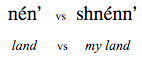
When a noun ends with n or n’, the n sound is lengthened when the noun is possessed. This is written as nn. Click below to hear Mrs. Irene Arnold illustrating the difference between n and nn. This also occurs with nouns that end in nh.
Tanacross n is a voiced alveolar nasal stop. In stem-initial position its phonetic realization varies between nasal [m], prenasalized [nd], and fully occluded [d]. Note that this fully occluded variant differs from the phoneme written d in the practical orthography, which is realized as a voiceless unaspirated stop [t]. Unlike the variation between the regular and occluded variants of the bilabial nasal, the occurrence of the occluded variant of the alveolar nasal is largely predictable. The occluded variant occurs stem-initially in stems which do not contain another nasal or nasalized vowel. Thus [nûun] 'animal' but [nduu] 'island'.
The distribution of the sounds [nd] versus [d] is more difficult to predict. For at least some speakers the pre-nasalized variant occurs following first-person singular voiced classifier, i.e., ish- and eg-.
medhegndax [meðɛgndax] 'I forgot'
medhildax [meðildax] 'you forgot'
In stem-final position the alveolar nasal may occur lengthened, written nn. Thus compare:
kón' 'fire'
shkónn' 'my fire'
Tanacross nh is a voiceless alveolar nasal stop. It occurs only in stem-final position. n is the voiced counterpart to nh, so that words which end in nh occur with n in their possessed forms.
menh 'lake'
Dihthâad Měnn' 'Mansfield Lake'
similar sounds