
The Tanacross Language
The Name Tanacross
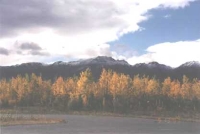 Tanacross is the ancestral language of the Mansfield-Ketchumstuk and Healy Lake-Joseph Village bands of Athabascan people, whose ancestral territory encompassed an area bounded by the Goodpaster River to the west, the Alaska Range to the south, the Fortymile and Tok Rivers to the east, and the Yukon Uplands to the north.
The word Tanacross has been used to refer both to a village in eastern Alaska and to the language spoken there. A more appropriate term may be Dihthâad Xt’een Iin Aanděeg’, literally The Mansfield People’s Language, referring to the traditional village of Dihthâad (Mansfield), north of Tanacross. The modern village of Tanacross is accessible by a short access road from the Alaska Highway, and some speakers now reside in the regional center of Tok, located approximately ten miles east of the village on the highway. In addition several speakers now reside in the nearest commercial center of Fairbanks, located two hundred miles downstream from Tanacross village and accessible by all-weather highway.
Relationship to Other Languages
Tanacross is one of a group of closely related languages which together comprise the Athabascan family. Tanacross is one of eleven Athabascan languages spoken in Alaska; another two dozen or so Athabascan languages are spoken outside Alaska. Athabascan is a language family in the same sense that the European languages form a family. That is, just as English, German, French, Spanish, Russian, etc. belong to the European family, so the various Athabascan languages of Alaska, Canada, the Pacific Coast and the Southwestern United States belong to the Athabascan family. Outside Alaska, Athabascan languages are often referred to as Dene, derived from the word for ‘person’ (in Tanacross the word is dendeh); however, the term Dene is not widely used in Alaska.
Language Structure
Athabascan languages differ in several ways from the European languages. One notable difference is the Sound System, which is exemplified in this CD. Another prominent difference is the structure of words. It is often noted that Athabascan may correspond to an entire sentence in English. For example, consider the Tanacross word tâatihdaał. This word is actually composed of at least seven individual parts:
tá-na-t-ih-d-haa-ł
home-back-future-I-back-walk-future
‘I will go back home’
These various bits of the word combine in a regular way to form the actual word tâatihdaał. Of course, not every Tanacross word is this complicated. But one common feature of Athabascan languages is that the verb word contains information about who is doing the action: I, you, she/he, etc. For example,
ghihhaał ‘I am walking.’
ghinhaał ‘You are walking.’
aahaał ‘She or he is walking.’
While it is possible to form the equivalent of an entire English sentence with one Tanacross word, many Tanacross sentences do contain more than one word. Learners will notice that the order of words in Tanacross sentences is different than that in English.
teltsêdz nek-‘ęh
mouse I see
‘I see a mouse’
Meaning
Another area in which Tanacross differs substantially from languages like English is in the area of meaning. Learners often seek the answer to the question: "How do I say X in Tanacross?" In some cases this question is not so easy to answer. The problem is that there is not a one-to-one equivalence between Tanacross words and English words. For example, Tanacross has different root words to refer to one person walking, more than one person walking, and animals walking. Note the difference in the stem forms at the end of each Tanacross word below: -haał, -déł, and -‘és.
aahaał ‘he is walking along’
xaadéł ‘they are walking along’
ah’és ‘(animals) are walking along’
So, the answer to the question: “How do I say ‘walk’ in Tanacross?” is: “it depends.” Similarly, Tanacross uses different words for referring to objects being in position or handling objects, depending on the nature of the object. For example,
ee’ąą ‘a single compact object (such as rock) is lying there’
eekąą ‘liquid (in a container) is lying there’
eetąą ‘a single elongated object (such as stick) is lying there’
Sounds
Another way in which Tanacross differs from English is in its sound system. Tanacross contains a number of sounds which are not found in English; it also makes use of a number of sounds which are similar to those in English but which are organized in a different way in Tanacross. You can find out more about these sounds and how they are produced by using this site.