
Letter K
Letter k is pronounced slightly differently depending on whether it is at the start or end of a syllable. At the start of a syllable, Tanacross k has a raspy quality similar to letter x. At the end of a word, letter k does not have this raspy quality and is similar to English k sound in words such as 'rock'.Click on a video below to see and hear Mrs. Irene Arnold pronouncing words with K.
kol none
nek-'ęh I see (it)
shké' my foot
elok it's hot!
koth cold, flu
eek coat
The k sound is similar to other sounds in Tanacross. Below are examples that contrast these similar sounds.
Click below to hear Mrs. Laura Sanford illustrating the difference between k and x at the start of syllables.
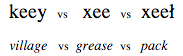
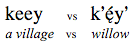
Click below to hear Mrs. Irene Arnold illustrating the difference between k and k’ at the start of syllables.
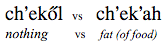
 Sentences contrasting velar sounds -- sounds produced in the back of the mouth.
Gah gha xuu'éł naxghogdek. I am telling them a story about a rabbit.
Naagêddh ké' k'ée shgáal' aaxá' nék-'ęh. I see fox tracks near my rabbit snare.
Wuk'îig yaashěg' ts'enh xetl gaay xaaxeeł. They are packing the small sled down from the distant ridge.
Tanacross k and g are phonologically voiceless aspirated and unaspirated velar stops /kh/ and /k/, respectively. However, in stem-initial position these sounds are heavily affricated, being realized as [kx] and [kɣ] (or even [gɣ]), respectively. For this reason learners often confuse the sounds k and x, and the sounds g and gh.
At the end of syllables k and g are pronounced as voiceless and voiced stops [k] and [g].
similar sounds