
Letter E
The short letter e is pronounced in several different ways. In some cases it has the same sound as long ee, only shorter in duration. However, in other cases short e has a different pronunciation, as demonstrated below.Click on a video below to see and hear Mrs. Irene Arnold pronouncing words with E.
ch'etheth its hide
ehts'eyh it is windy
ts'éhxeh woman
tthek fence
deshax his, her or its own house
tuutheł soup
Letter e varies quite a bit in pronunciation.
Click below to hear Mrs. Irene Arnold pronouncing words illustrating four different pronunciations of letter e.
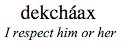 | letter e resembles the e in English "bed" |
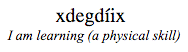 | letter e resembles the a in English "had" |
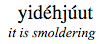 | letter e resembles the a in English "paper" | 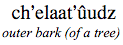 | letter e resembles the a in English "sofa" |
Tanacross orthographic e actually represents two distinct phonemes: a mid-front vowel /e/ and a lowered mid-front vowel /ɛ/. The contrast between these phonemes is neutralized in stem (final) syllables, where the lowered variant occurs preceding glottal consonants and the raised variant occurs elsewhere. Thus compare -ke' [-keʔ] 'foot' versus k'et[k'ɛt] 'on'.
In prefix syllables orthographic e may represent either of the phonemes /e/ or /ɛ/. However, preceding a glottal consonant e is realized as /e/.
In contrast, long ee always corresponds to the mid-front vowel phoneme /e/ and is pronounced as [e]. Thus, in existing Tanacross materials long ee is often used to represent both short /e/ and short /ɛ/. In practice, in prefix syllables short e is used almost exclusively to indicate vowel length (short) rather than quality. Thus, in the first example below the e in the first syllable is short, whereas, in the last example the ee in the first syllable (corresponding to the postpositional object prefix nee- is long. In the second example short e represents a lowered mid-front vowel.
mech’axdekdiix [mečaxdɛktiix] 'I am teaching him'
xetlghihtiił [xɛtlghihthiił] 'I am driving a sled'
nee'ech’axdehdiix [nee'ečaxdehtiix] 'she is teaching us'
similar sounds