
Letter ' (glottal stop)
The glottal stop is wrtten with an apostrphe ( ’ ). It is a distinct sound from the ejective sound which is also written with an apostrophe. It is pronounced as a slight "catch in the breath". It is called a "glottal stop" because the vocal cords are held tightly together, stopping air from moving from the lungs and into the mouth. This is the same sound which occurs in the middle of the English expression 'uh-oh' (although it is not written with an apostrophe in English).Click on a video below to see and hear Mrs. Irene Arnold pronouncing words with ' (glottal stop).
n'aat your wife
shuusí' my name
ąą yes
ntá' your father
taats'el'ók we are swimming
nén' the land
Note that when a word begins with a glottal stop the apostrophe is not written. Thus, words which are written with an initial vowel are pronounced with an initial glottal stop.
It is important to distinguish between the presence and absence of glottal stop at the end of words. Click below to hear Mrs. Irene Arnold and Mrs. Laura Sanford pronouncing words illustrating the contrast in words ending with and without glottal stop.
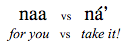
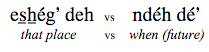

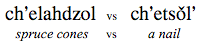
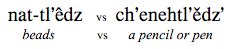
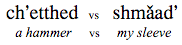
Tanacross apostrophe ’ is a voiceless glottal stop. Though written with an apostrophe, it is important to remember than Tanacross glottal stop is a full-fledged consonant, not a punctuation mark. In the practical orthography glottal stop is not written at the beginning of words. Words which are written with an initial vowel are pronounced with an initial glottal stop. Thus, eek 'dress' is pronounced as if it were spelled ’eek. When prefixes are added which cause the glottal stop to no longer occur at the beginning of the word, then the apostrophe representing the glottal stop must be written. For example, when the first-person possessive prefix is attached to this word the result is sh’eeg' 'my dress', and not sheeg' .
Note that the apostrophe is also used to indicate ejective sounds tth', t', ts', tl', ch', k'. However, the glottal stop is not an ejective sound. When there is potential for confusion between an apostrophe meant to represent a glottal stop and an apostrophe which represents an ejective, a hyphen is used to ensure that the sound is pronounced as a glottal stop. For example, nek-'ęh 'I see' contains a k followed by a glottal stop (not a k').