
Letter Ł (barred-L)
Letter ł is called barred L or Indian L, and is made with the tongue in the same place as the plain l. Like plain l, air moves out of the mouth by going around the sides of the tongue. Unlike l, the sound ł is voiceless and is made with friction, so it sounds a bit rough.Click on a video below to see and hear Mrs. Irene Arnold pronouncing words with Ł (barred-L).
łuug fish
łii dog
gáał snare
nach'ekłóx I am fishing
tl'uuł rope
The ł sound is similar to other sounds in Tanacross. Below are examples that contrast these similar sounds.
Click below to hear Mrs. Irene Arnold illustrating the difference between ł and l at the start of words.
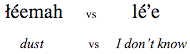
Click below to hear Mrs. Irene Arnold illustrating the difference between ł and ł at the start of syllables.
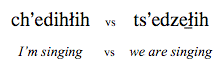
Click below to hear Mrs. Irene Arnold illustrating the difference between th and ł at the end of words.
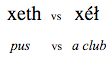
Click below to hear Mrs. Laura Sanford illustrating the difference between tl and ł at the end of words.
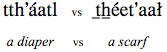
Letter ł sometimes occurs at the beginning of a word, forming a syllable all by itself. Click on the Tanacross word below to see and hear Mrs. Irene Arnold pronouncing words with ł as the first syllable a word.

door

two

peninsula
Tanacross ł is a voiceless lateral fricative [ɬ], and l is a voiced lateral approximant [l]. While l is phonetically an approximant, it patterns phonologically as the voiced counterpart to the voiceless lateral fricative, participating in all relevant phonological voicing alternations which apply to other fricatives. Neighboring languages, such as Han, exhibit a voiced lateral fricative corresponding to the Tanacross l
Letter ł is a semi-voiced fricative. It can generally be described as beginning voiceless and transitioning to a fully voiced fricative.