About the Project
The Tanacross Learners' Dictionary — compiled by Irene Solomon Arnold, Gary Holton, and Rick Thoman — is a community-based reference for anyone wanting to learn the spoken Tanacross language.
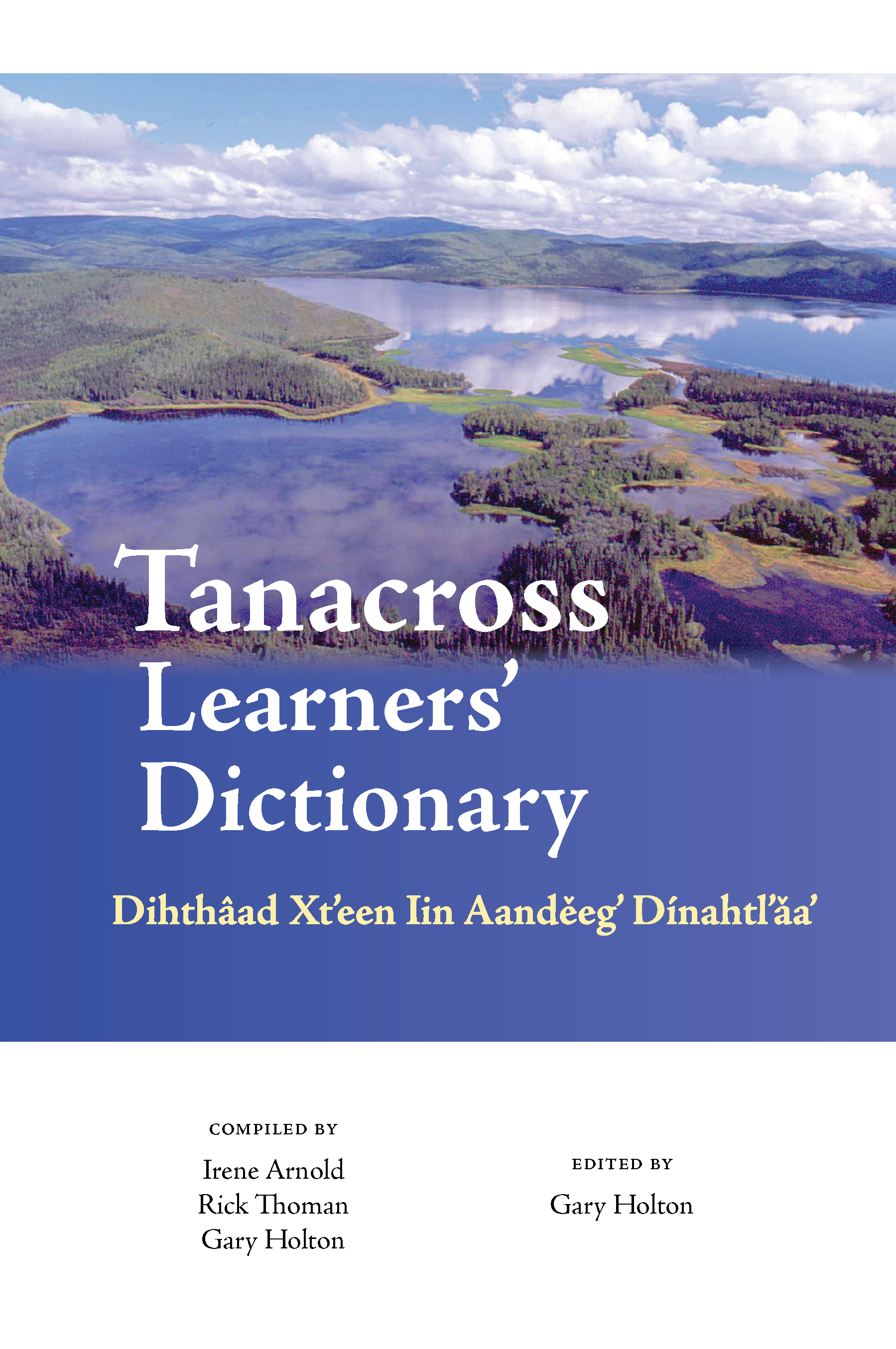 The dictionary is intended as a reference for anyone wanting to learn the spoken Tanacross language. The subject matter and the level of complexity are varied enough to make it a useful resource for a wide range of users — from people who know nothing of the language to those who already know some words and phrases or have heard the language spoken by their parents or grandparents. The dictionary consists of about 2,000 English entry words with nearly 4,500 Tanacross words and example sentences, and clickable audio recordings of Tanacross words and sentences.
The Tanacross Learners' Dictionary is a community-based project. The vocabulary is considered acceptable by most speakers. Nonetheless, some words are pronounced differently by various speakers and there is often more than one way to say something. Some of these differences are included in the dictionary, but the vocabulary should not be considered the only correct way to say something. The vocabulary has been approved by Elders working closely with the project, who wanted to emphasize vocabulary of many traditional activities. Therefore, there is extensive vocabulary for activities such as fishing, camping, and skin preparation, and many example sentences also refer to traditional activities.
Background and Sources
This dictionary has a long history. Through the efforts of people such as Nancy McRoy, Ron Scollon, Alice Brean, and James Kari, a number of wordlists and dictionary manuscripts were compiled at the Alaska Native Language Center between 1973 and 1991. Dictionary work began again in 1997 as part of field work by Gary Holton, but that effort was focused on a scientific, stem-based dictionary. After Irene Arnold began teaching Tanacross language classes through the University of Alaska Fairbanks in 2000, it was recognized that students needed a more accessible vocabulary reference, preferably one accompanied by audio recordings. One of those students, Rick Thoman, persevered to make the present Learners' Dictionary come into reality.
After an exhaustive survey of existing Alaska Athabascan "Junior" dictionaries, Thoman compiled a preliminary English wordlist, which was entered into a Shoebox database. Thoman then devoted several years to compiling Tanacross translations, recording Tanacross forms, and researching dictionary presentation formats. This work resulted in Thoman's 2004 University of Alaska Fairbanks M.A. thesis.
Many sources have been consulted for this dictionary, but the vocabulary remains grounded in and inspired by the language classes taught by Irene Arnold. This classroom vocabulary has been supplemented by archival data and consultations with other Tanacross speakers. More than a dozen language workshops have been held in the Tanacross area since 1998, including three focused on the Tanacross Learners' Dictionary. As with any dictionary project, it is difficult to know when to stop compiling and revising — there are many more Tanacross words and phrases to be recorded.
About the Editors
Irene Solomon Arnold is a native speaker of Tanacross and a trained bilingual teacher, holding an Associate of Applied Sciences Degree in Native Language Education from Yukon College and the University of Alaska Fairbanks.
Gary Holton is Professor of Linguistics at the University of Hawaiʻi at Mānoa and former Director of the Alaska Native Language Archive. His research focuses on the documentation of endangered languages, especially Athabascan; revitalization of Alaska Native languages; and the development of standards for digital language archiving.
Rick Thoman holds a Master of Arts in Linguistics and Alaska Native Languages from the University of Alaska Fairbanks. Participating in the compilation of the Tanacross Learners' Dictionary was his Master of Arts project.
Credits
Funding for this project was provided in part by a grant from the National Science Foundation (NSF-OPP 0136113). Any opinions, findings, and conclusions or recommendations expressed in this material are those of the compilers and do not necessarily reflect the views of the National Science Foundation.
Banner artwork by Gary John. Used with permission.